
A listing on a popular e-commerce site (call it Yangtze.com) for a book published by Penguin Classics called “Early Christian Writings” (also known as ‘The Apostolic Fathers’) contains a significant number endorsing comments, especially from those evangjellycals who decry the state of the church today. These examples illustrate the gist of the comments:
“WOW! We have writings of early trusted church pastors!”
and
“What Christianity Really Was”
Now I appreciate the enthusiasm, but really, it’s zeal without education. These documents have been around for a while now, having been discovered (not all at once) in various places in the east (e.g., Constantinople, Syria) from 1592 to 1883. They are referenced in other extant documents (such as the third-fourth century work “Ecclesiastical History” by Eusebius of Caesarea). I am wholly in favor of their close study and dissemination. The recovery of these documents containing pastoral letters and tenets of early church practice is massively significant, and it’s a good thing also that the documents are widely accepted as genuine. Here’s a list of them:
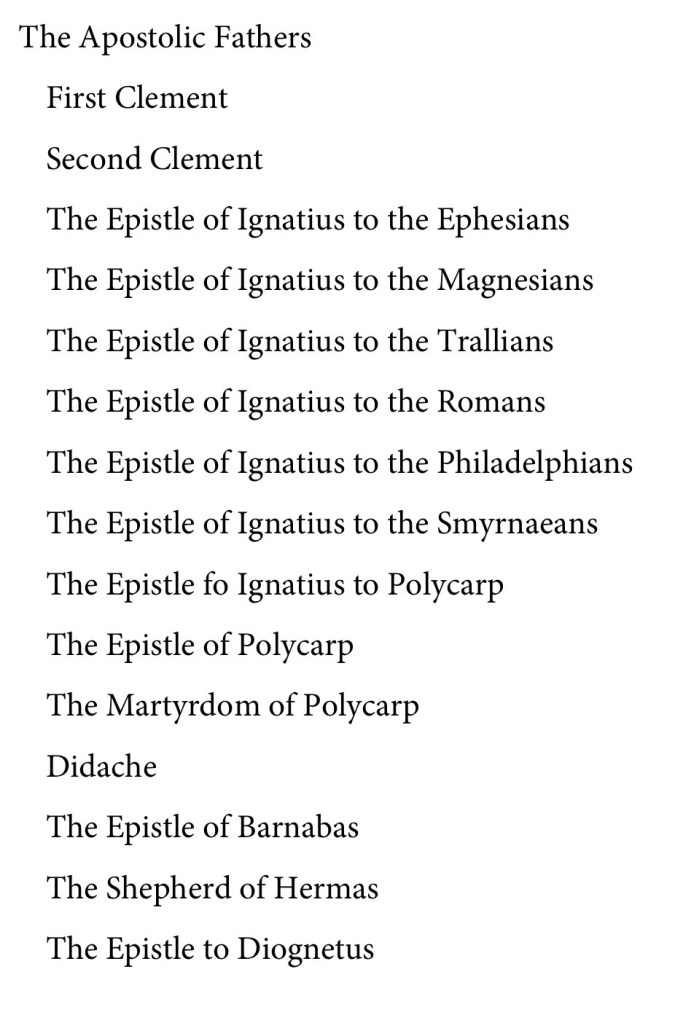
As significant as these documents are to our understanding of early church life, it must be understood that these documents are of a historical nature and NOT inspired scripture. We cannot use these documents to say that the church today ought to be like this or like that, unless of course there is a scriptural reason for it.
There is a kind of fallacy that exists among certain evangelicals that if we can get back to the way things were in the “New Testament Church,” all would be as God wills it to be.
But the problem is, that the “NT church” (as it is imagined by some) is an abstraction without basis – a kind of fantastical and idyllic vision of something which never really was in reality (at least not as these modern day decriers of the church of today imagine it). The church in the world has always had her conflicts, her brushes with worldliness and decline, and never has she (the visible one anyway) been truly pure and undefiled by the world.
Decriers appeal to an idiosyncratic romanticism – as though the church was pure and right when she was free of the contamination that came with state control and entanglement. And even granting the harm and defilement which arose from state involvement, such decriers make a dangerous admission (one they themselves do not realize) that God is not in charge of the course of his church. But, as we say, He certainly is in charge of all His creatures and all their actions, and that affirmation expressly includes His direction of the ‘ups’ AND the ‘downs’ in His church’s history. For has not even her failures led to her humiliation and chastisement? …even also to her repentance, renewal, and reformation?
We can’t go back, and that’s a good thing.
A desire or assumption that the church, to be what God wants it to be, is to revert to all that we see in these documents is a (possibly unwitting) tacit denial that God has led us by his Holy Spirit, through all ages, preserving his church, preserving his Word pure in all ages, preserving the true worship and the true biblical doctrine of the church through every challenge, every heretical denial, and every corruption of leadership in all ages as well. There has always been the true people of God, the body of Christ called and gathered by the Spirit, according to will of God, in this world both visibly and invisibly, from Adam to this day, and there always will be – until (and after) He comes again.
Maranatha!
 Musings from WinDSwept Junction
Leave a comment